Water can travel behind drywall, beneath flooring, and into other building materials without leaving an obvious surface clue. When that happens, restoration professionals use a combination of visual inspection, thermal imaging, moisture meters, moisture mapping, and follow-up readings to determine where moisture may be hiding and whether affected materials are drying properly.
For homeowners in Spokane, Spokane Valley, Coeur d’Alene, Post Falls, and surrounding communities, this process can be especially important after a plumbing leak, appliance failure, burst pipe, flooding event, or other water loss.
Why Hidden Moisture Can Be Difficult to Find
Water does not always stay near the place where a leak begins.
Depending on the source of the water and the materials involved, moisture may:
- Move beneath flooring
- Wick upward through drywall
- Spread behind baseboards
- Reach insulation inside a wall cavity
- Travel into an adjoining room
- Move from one floor of a home to another
- Collect beneath cabinets or other finished surfaces
A ceiling stain may even appear some distance from the original leak because water can follow framing, pipes, or other building materials before it becomes visible. This means the area you can see is not always the full extent of the water damage. A professional inspection helps answer a more useful question: Where did the water actually go?
A Professional Moisture Inspection Starts With the Visible Damage
Specialized equipment plays an important role in moisture detection, but the process usually begins with a visual inspection. Restoration technicians look at the affected area and consider where the water came from, how long it may have been present, and which surrounding materials could have been exposed.
They may look for signs such as:
- Water stains or discoloration
- Swollen or softened drywall
- Warped or lifting flooring
- Peeling paint
- Damp baseboards or trim
- Damage around cabinets
- Wet insulation
- Moisture in an adjoining room
- Ceiling damage below an upstairs leak
The source and location of the loss can also help determine where technicians should investigate next. For example, water from a second-floor bathroom may affect the bathroom flooring, nearby walls, the ceiling below, insulation, or an adjacent room. Looking only at the original puddle could miss part of the damage.
How Thermal Imaging Is Used During Water Damage Inspections
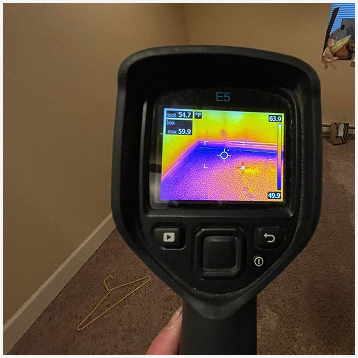
Thermal imaging cameras can help restoration professionals quickly scan walls, ceilings, floors, and other surfaces for temperature differences.
Wet materials may sometimes have a different surface temperature than surrounding dry materials, especially when evaporation is taking place. These temperature patterns can help technicians identify areas that may need additional testing.
Thermal imaging may be useful when evaluating:
- Walls around plumbing leaks
- Ceilings below bathrooms or roof leaks
- Flooring around appliance failures
- Larger areas where the extent of water movement is unclear
- Rooms adjacent to visible water damage
However, a thermal imaging camera does not directly see water behind a wall. A temperature difference can have many causes, including insulation, airflow, sunlight, heating or cooling equipment, or differences in construction materials.
For that reason, thermal imaging is generally used as a screening tool rather than proof that a material is wet. If an area looks suspicious, technicians can take moisture readings to investigate further.
What Moisture Meters Can Reveal
Moisture meters help restoration professionals evaluate the moisture content or relative moisture condition of building materials.
Depending on the equipment and material being tested, technicians may use different types of meters to check areas such as:
- Drywall
- Wood
- Flooring
- Subflooring
- Ceilings
- Trim
- Other structural materials
Rather than relying on one isolated reading, technicians can compare suspected wet areas with materials in unaffected parts of the property.
This helps establish a baseline.
If a section of drywall near a leak shows elevated moisture readings, for example, the technician may continue testing farther away from the source until the readings return closer to those found in unaffected areas. That process helps determine how far the water may have spread.
What Is Moisture Mapping?
Moisture mapping is the process of documenting moisture readings throughout an affected area. Instead of checking only the location where water is visible, technicians take readings at multiple points to better understand the boundaries of the water damage.
The resulting map may identify:
- Areas with elevated moisture
- Materials that appear unaffected
- Locations that need drying
- Areas that need additional monitoring
- Changes in moisture levels over time
Think of moisture mapping as creating a working picture of the water loss. A homeowner may see one wet wall, while moisture readings show that water has also traveled beneath the flooring or into a neighboring wall. That information can help the restoration team develop a drying plan based on actual conditions rather than appearance alone.
Why Follow-Up Moisture Readings Matter
Moisture detection does not end with the first inspection.
During professional water damage restoration, technicians may return to affected areas and take additional readings throughout the drying process.
These follow-up readings help answer an important question: Are the materials actually getting drier?
A wall, floor, or ceiling may feel dry on the surface while moisture remains deeper within the material or underneath another layer. By checking the same locations over time, restoration professionals can monitor whether moisture levels are decreasing as expected.
If readings are improving, the current drying setup may continue. If a particular area is not drying properly, technicians can investigate possible reasons, such as:
- Moisture trapped beneath another material
- Insufficient airflow
- Equipment placement
- A continuing water source
- Saturated insulation
- A material that cannot realistically be dried in place
This ongoing monitoring helps guide decisions throughout the restoration process.
How Moisture Findings Guide the Drying Plan
Moisture-detection equipment is not simply used to confirm that something is wet. The findings help restoration technicians decide how the affected property should be dried.
Depending on the loss, the inspection may help determine:
- Which rooms need drying equipment
- Where air movers should be positioned
- Where dehumidification is needed
- Whether water reached adjoining areas
- Which materials may be dried in place
- Whether access to a wall cavity or floor system is necessary
- Which areas require continued monitoring
- When drying goals have been reached
Other factors also affect these decisions.
The source of the water, how long the materials were wet, the type of building material, and any contamination concerns can all influence whether a material should be dried, cleaned, removed, or replaced. That is why moisture readings are one part of a larger professional assessment.
Can Thermal Imaging Find Water Behind Drywall?
Thermal imaging can help identify temperature patterns that suggest an area deserves additional investigation, but it cannot confirm hidden water by itself. A restoration technician may first notice an unusual thermal pattern and then use a moisture meter to determine whether the material actually has elevated moisture.
Using the tools together provides more useful information than relying on either method alone. If you are specifically concerned about moisture inside a wall assembly, you can also learn more about what happens when water gets in your walls.
Can You Check for Hidden Moisture Yourself?
Homeowners can watch for signs of possible hidden water damage, but determining the full extent of moisture can be difficult without professional equipment.
Warning signs may include:
- Water stains that continue expanding
- Soft or swollen drywall
- Flooring that begins lifting or warping
- Peeling paint
- Damp baseboards
- Musty odors
- Moisture appearing in a neighboring room
- A ceiling stain below a plumbing fixture or appliance
These signs can tell you that further investigation is needed, but they do not necessarily show how far the water has traveled. If a significant leak has affected drywall, flooring, ceilings, insulation, cabinetry, or other concealed areas, professional moisture detection can provide a clearer picture of the damage.
Find Hidden Moisture Before It Becomes a Bigger Problem
The most visible water damage is not always the only water damage. Professional restoration technicians use visual inspections, thermal imaging, moisture meters, moisture mapping, and follow-up readings to evaluate where water has traveled and how affected materials are responding to drying.
Each tool serves a different purpose. Thermal imaging can help identify areas that deserve closer inspection. Moisture meters provide more direct information about affected materials. Moisture mapping helps define the boundaries of the loss, while follow-up readings help track drying progress.
Together, those findings help guide the restoration process.
AllKlean provides professional water damage restoration throughout Spokane, Spokane Valley, Coeur d’Alene, Post Falls, and surrounding communities. Our team evaluates affected areas, identifies hidden moisture when possible, develops an appropriate drying plan, and monitors conditions throughout the restoration process.
If a leak, appliance failure, burst pipe, or flooding event has left you wondering whether moisture remains behind the surface, contact AllKlean for professional water damage restoration.